Agasild et al. 2025. Cladoceran Chydorus sphaericus and colonial cyanobacteria: potentially a toxic relationship?. Toxins, 17(6), p.298.
Cyanobacterial blooms represent a growing concern for freshwater ecosystems, as toxin-producing species may disrupt ecological processes and influence aquatic food web dynamics. Investigating the interactions between zooplankton and potentially toxic cyanobacteria provides valuable insights into their ecological relationships, potential toxin transfer, and associated risks to freshwater ecosystem health.
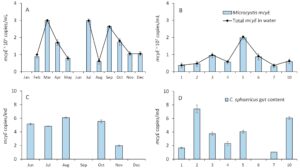
In a study published in Toxins in 2025, Agasild et al. investigated the feeding behavior of the small cladoceran Chydorus sphaericus on colonial cyanobacteria, including potentially toxic Microcystis, in Lake Võrtsjärv, Estonia. Using high-performance liquid chromatography (HPLC) to analyze gut pigments and quantitative PCR (qPCR) to detect the mcyE gene, the researchers examined feeding preferences and the ingestion of potentially toxin-producing cyanobacteria under natural conditions.
The findings revealed that cyanobacteria accounted for approximately 80% of the ingested algal pigments, with a strong preference for colonial forms. Potentially toxic Microcystis cells were detected in the gut contents of C. sphaericus, even when their abundance in lake water was low. These results suggest that this common zooplankton species may facilitate the transfer of potentially toxic cyanobacteria to higher trophic levels.
The study highlights the importance of considering zooplankton feeding interactions when assessing cyanobacterial risks. It also demonstrates how molecular and chromatographic methods can improve our understanding of toxin-producing cyanobacteria within aquatic food webs.
The publication acknowledges CYANOACTION (COST Action CA23160) for its valuable contribution to knowledge sharing and scientific networking. This recognition highlights the importance of international collaboration in advancing research on harmful cyanobacteria and their ecological impacts.
Read the full open-access article in Toxins: https://www.mdpi.com/2072-6651/17/6/298