Agasild et al. 2025. Crustacean zooplankton ingestion of potentially toxic Microcystis: In situ estimation using mcyE gene gut content detection in a large temperate eutrophic lake. Toxins, 17(1), p. 42.
Harmful cyanobacterial blooms pose significant threats to freshwater ecosystems and water quality. Among bloom-forming cyanobacteria, Microcystis is of particular concern due to its potential to produce microcystins. Understanding how potentially toxic cyanobacteria are consumed by zooplankton is essential for assessing their movement through aquatic food webs and associated ecological risks.
In a study published in Toxins in 2025, Agasild et al. investigated the ingestion of potentially toxic Microcystis by crustacean zooplankton in Lake Peipsi, a large eutrophic lake in Northern Europe. Using molecular detection of the mcyE gene in zooplankton gut contents, the study provided an in-situ assessment of feeding interactions under natural environmental conditions.
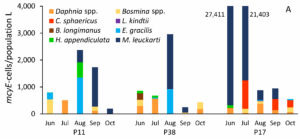
The results demonstrated that potentially toxic Microcystis was consumed by different zooplankton groups, with notable variations among species and seasons. Copepods, particularly Mesocyclops leuckarti, showed an important role in the ingestion of potentially toxic cells, sometimes exceeding that of cladocerans. These findings highlight the influence of zooplankton community composition on cyanobacterial grazing and potential toxin transfer through freshwater food webs.
The study contributes to a better understanding of cyanobacteria–zooplankton interactions and demonstrates the potential of molecular methods to support ecological monitoring and cyanotoxin risk assessment.
The publication acknowledges CYANOACTION (COST Action CA23160), alongside CYANOCOST and WATERTOP-COST, for valuable knowledge sharing and scientific networking. This recognition highlights the importance of international collaboration in advancing research on harmful cyanobacterial blooms and their ecological impacts.
Read the full open-access article in Toxins: https://www.mdpi.com/2072-6651/17/1/42