Collaro et al. Comprehensive Profiling of Microcystins in Non-Targeted LC-HR-MS Datasets using Mass Spectrometry Query Language (MassQL). Preprint on ChemRxiv
Harmful cyanobacterial blooms present an escalating threat to global water resources. Microcystins (MCs) are the most frequently detected class of cyanotoxins, with strict regulatory limits for variants like MC-LR in drinking water. However, environmental monitoring faces a massive analytical bottleneck: there are currently over 300 known MC congeners, yet commercial reference standards and public MS/MS spectral libraries exist for only a small fraction of them. Consequently, traditional targeted analyses and standard molecular networking often fail to detect novel or rare MC variants, leaving potential risks to public health unidentified.
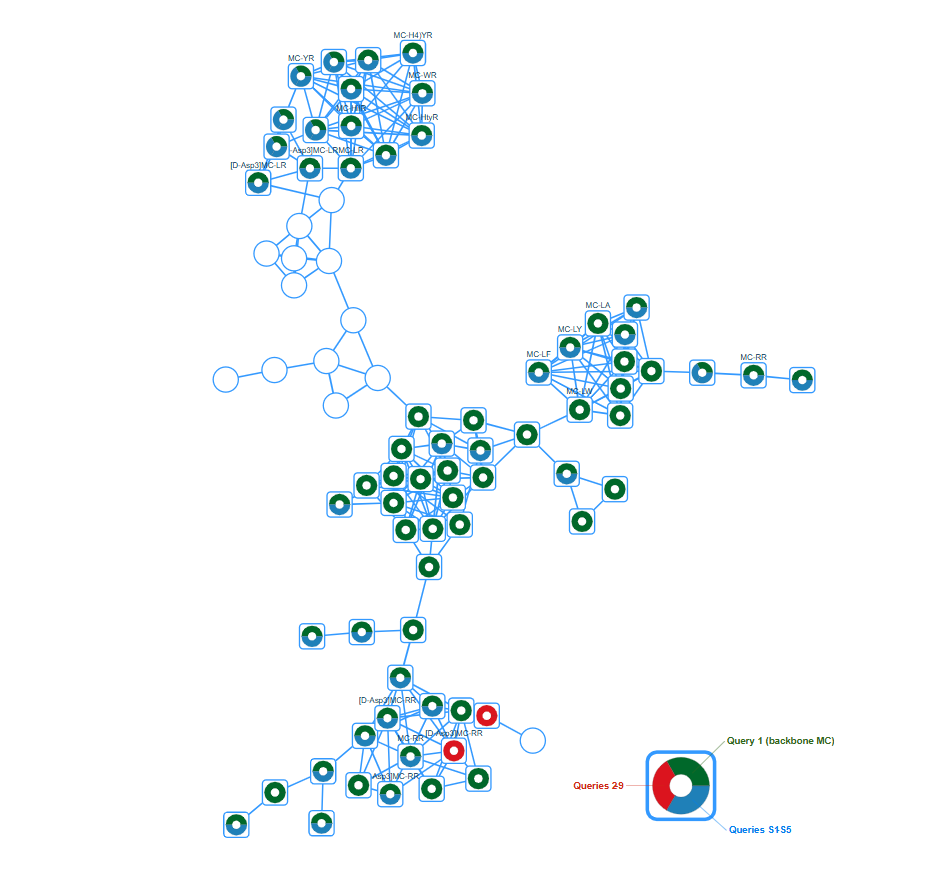
To address this critical gap, researchers within the CyanoAction network (COST Action CA23160) have developed and validated a highly targeted informatics workflow using the Mass Spectrometry Query Language (MassQL). Rather than relying on exhaustive reference libraries, this novel approach translates the chemical diversity and conserved fragmentation rules of MCs into logic-based algorithms. As detailed in our newly released ChemRxiv preprint, the team designed specific query sets capable of detecting both the conserved MC backbone and structurally specific subgroups directly from raw high-resolution mass spectrometry (HRMS) data. When utilized as an orthogonal tool to Feature-Based Molecular Networking (FBMN), MassQL strictly filters out false-positive annotations and successfully identifies completely novel “unknown-unknown” MC congeners that would otherwise be missed.
The implications of this workflow extend far beyond the laboratory. Scientifically, it equips the analytical chemistry and metabolomics communities with a robust, open-source, and highly specific toolkit to bypass spectral library dependencies. The method is readily adaptable across diverse qTOF and Orbitrap platforms. Societally, this framework provides water authorities, environmental agencies, and water treatment utilities with an enhanced capacity for comprehensive risk assessment. By accurately profiling the true chemical diversity of a cyanobacterial bloom, stakeholders can make more informed decisions regarding water safety and treatment interventions.
This research is a direct outcome of a CyanoAction Virtual Mobility (VM) Grant awarded to Triantafyllos Kaloudis. The grant mechanism facilitated a highly effective virtual networking environment, enabling the coordination of multiple research groups and laboratories across the CyanoAction network. By pooling diverse in-house cyanobacterial datasets, sharing analytical expertise, and collaboratively validating the computational queries across different instrument architectures, this publication exemplifies the power of borderless, cross-disciplinary cooperation in addressing urgent environmental challenges.
Read the full preprint (Comprehensive Profiling of Microcystins in Non-Targeted LC-HR-MS Datasets using Mass Spectrometry Query Language (MassQL) on ChemRxiv: https://chemrxiv.org/doi/full/10.26434/chemrxiv.15011678/v1