
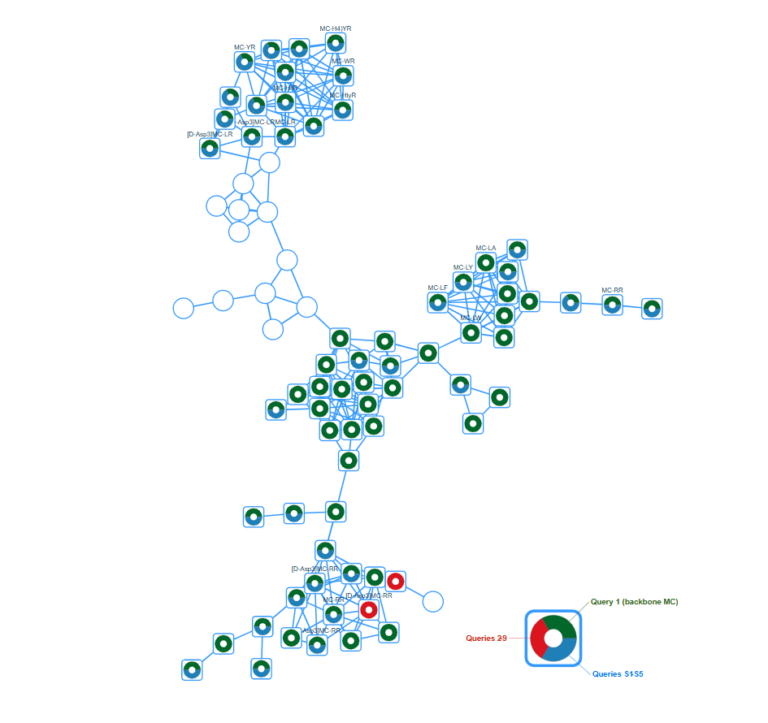
Overcoming Analytical Bottlenecks in Cyanotoxin Monitoring: A Collaborative MassQL Workflow for Microcystins
Collaro et al. Comprehensive Profiling of Microcystins in Non-Targeted LC-HR-MS Datasets using Mass Spectrometry Query Language (MassQL). Preprint on ChemRxiv
Monitoring Microcystins and Water Quality: Seasonal Insights from Krasava Reservoir
Mitreva, M., Pavlova, V. and Georgieva, V., 2026. Seasonal dynamics of microcystins, nutrients, and phytoplankton in Krasava Reservoir (2024-2025). Bulgarian Journal of Public Health.
Exploring the Role of Zooplankton (Cladoceran Chydorus sphaericus) in the Transfer of Potentially Toxic Cyanobacteria
Agasild et al. 2025. Cladoceran Chydorus sphaericus and colonial cyanobacteria: potentially a toxic relationship?. Toxins, 17(6), p.298.
Tracking Potentially Toxic Cyanobacteria Through Aquatic Food Webs: Insights from Zooplankton Research
Agasild et al. 2025. Crustacean zooplankton ingestion of potentially toxic Microcystis: In situ estimation using mcyE gene gut content detection in a large temperate eutrophic lake. Toxins, 17(1), p. 42.
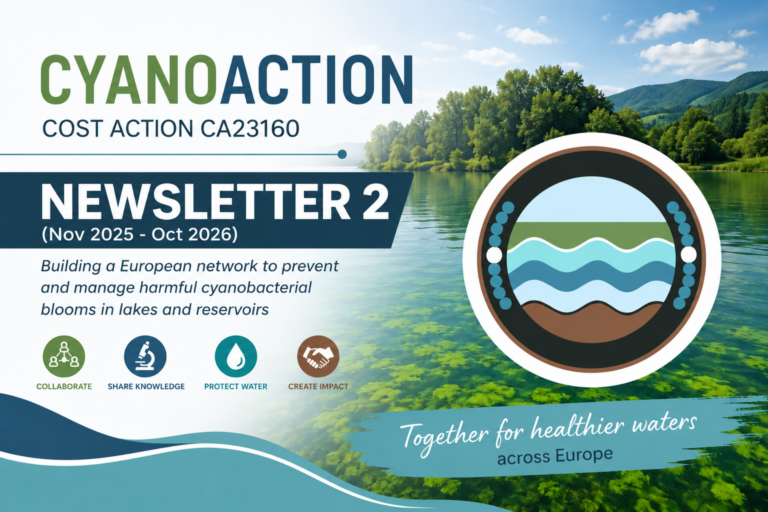
CYANOACTION Newsletter – Volume 2 Now Available!
October 2026 | Highlights from Grant Period 2 (November 2025 – October 2026) We are pleased to announce the release of the second edition of the CYANOACTION Newsletter, highlighting the
CYANOACTION: Reducing Cyanobacterial Blooms through Catchment-Based Lake Management
Wiegand, C., Bormans, M. and Quiblier, C., 2026. CYANOACTION-COST Action CA23160, effective lake management: reduction of cyanobacteria through actions in the watershed. Environnement, Risques & Santé, 25(4), pp.290-292.